 Add to Chrome
 Add to Firefox
 Add to Edge
Low Rank for Rank: Uncertainty-Aware Task-Specific LLM Ranking under Sparse Pairwise Comparisons
May 28, 2026
Pairwise human-preference platforms such as Chatbot Arena have become central to large language model (LLM) evaluation, yet reliable task-specific ranking remains challenging. Global leaderboards mask task heterogeneity, while ranking each fine-grained task independently is unstable under sparse, imbalanced comparisons. We propose a low-rank framework for task-specific LLM ranking from sparse pairwise comparisons, modeling the task-by-model ability matrix $Θ^\star \in \mathbb{R}^{d_t \times d_m}$ as low rank so that information is shared across related tasks while task-specific differences are preserved. We first develop a max-norm ($\ell_\infty$) accurate estimator for the latent scores, combining a convex initializer with alternating-minimization refinement, and prove task-wise top-$K$ recovery guarantees under sparse sampling. Our main contribution is an uncertainty quantification framework for task-specific ranking. We construct cross-fitted one-step debiased estimators for fixed score contrasts -- such as the task-specific ability gap between two models -- yielding asymptotically valid confidence intervals that attain the semiparametric efficiency bound. We then extend the inference to the high-dimensional ranking regime, where per-task ranks and top-$K$ membership are determined by many dependent score-gap hypotheses. Using Gaussian and multiplier-bootstrap calibration, we obtain simultaneous confidence sets for per-task ranks and valid top-$K$ membership tests across many tasks and models. Experiments on synthetic data and Chatbot Arena show that low-rank sharing improves sample efficiency over independent task-wise Bradley-Terry estimation and produces tighter, better-calibrated ranking certificates, with the largest gains in the sparse regime typical of real LLM benchmarks.

When Should an AI Workflow Release? Always-Valid Inference for Black-Box Generate-Verify Systems
May 13, 2026LLM-enabled AI workflows increasingly produce outputs through iterative generate-evaluate-revise loops. Each iteration can improve the candidate, but it also creates a release decision: when to stop and output the current result? This raises a statistical challenge because deployment-time evaluator scores are adaptively generated and repeatedly monitored, yet the likelihood models or exchangeability assumptions typically used for calibration are unavailable. We propose an always-valid release wrapper for existing generator-evaluator pipelines. The wrapper builds a hard-negative reference pool of high-scoring failures, calibrates deployment-time evaluator scores against this pool, and accumulates the resulting evidence with an e-process. This separates two roles: the reference pool turns black-box scores into conservative evidence, while the e-process provides validity under optional stopping. In theory, we show that a conservative reference pool yields finite-sample control of the probability of releasing on infeasible tasks, that is, tasks for which the given workflow is not capable of producing a reliable solution. We also characterize conditions under which the same conservative rule still achieves nontrivial release on feasible tasks. In an MBPP+ coding-agent case study, the wrapper reduces premature incorrect release relative to baseline stopping rules while still releasing on tasks for which the workflow repeatedly accumulates moderate supporting evidence.
Policy-Aware Design of Large-Scale Factorial Experiments
Apr 09, 2026Digital firms routinely run many online experiments on shared user populations. When product decisions are compositional, such as combinations of interface elements, flows, messages, or incentives, the number of feasible interventions grows combinatorially, while available traffic remains limited. Overlapping experiments can therefore generate interaction effects that are poorly handled by decentralized A/B testing. We study how to design large-scale factorial experiments when the objective is not to estimate every treatment effect, but to identify a high-performing policy under a fixed experimentation budget. We propose a two-stage design that centralizes overlapping experiments into a single factorial problem and models expected outcomes as a low-rank tensor. In the first stage, the platform samples a subset of intervention combinations, uses tensor completion to infer performance on untested combinations, and eliminates weak factor levels using estimated marginal contributions. In the second stage, it applies sequential halving to the surviving combinations to select a final policy. We establish gap-independent simple-regret bounds and gap-dependent identification guarantees showing that the relevant complexity scales with the degrees of freedom of the low-rank tensor and the separation structure across factor levels, rather than the full factorial size. In an offline evaluation based on a product-bundling problem constructed from 100 million Taobao interactions, the proposed method substantially outperforms one-shot tensor completion and unstructured best-arm benchmarks, especially in low-budget and high-noise settings. These results show how centralized, policy-aware experimentation can make combinatorial product design operationally feasible at platform scale.
LLM Evaluation as Tensor Completion: Low Rank Structure and Semiparametric Efficiency
Apr 07, 2026Large language model (LLM) evaluation platforms increasingly rely on pairwise human judgments. These data are noisy, sparse, and non-uniform, yet leaderboards are reported with limited uncertainty quantification. We study this as semiparametric inference for a low-rank latent score tensor observed through pairwise comparisons under Bradley-Terry-Luce-type models. This places LLM evaluation in a new tensor completion setting with structured observations, non-uniform sampling, and pairwise contrasts. Our target is a smooth functional $ψ(T^\star)$, including linear estimands such as ability gaps and nonlinear ones such as win probabilities. We derive the information operator on the low-rank tangent space, the efficient influence function, and the semiparametric efficiency bound, then construct a one-step debiased estimator with asymptotic normality. A central challenge is that the information operator is anisotropic and does not commute with the tangent-space projection, creating a bottleneck absent from isotropic models. We introduce a score-whitening method that equalizes local Fisher information and restores stable inference at the optimal sample-complexity scale. Our results provide a principled framework for uncertainty quantification in LLM evaluation and more broadly for inference on low-rank structures from pairwise data.
Reinforcement Learning from Human Feedback: A Statistical Perspective
Apr 02, 2026Reinforcement learning from human feedback (RLHF) has emerged as a central framework for aligning large language models (LLMs) with human preferences. Despite its practical success, RLHF raises fundamental statistical questions because it relies on noisy, subjective, and often heterogeneous feedback to learn reward models and optimize policies. This survey provides a statistical perspective on RLHF, focusing primarily on the LLM alignment setting. We introduce the main components of RLHF, including supervised fine-tuning, reward modeling, and policy optimization, and relate them to familiar statistical ideas such as Bradley-Terry-Luce (BTL) model, latent utility estimation, active learning, experimental design, and uncertainty quantification. We review methods for learning reward functions from pairwise preference data and for optimizing policies through both two-stage RLHF pipelines and emerging one-stage approaches such as direct preference optimization. We further discuss recent extensions including reinforcement learning from AI feedback, inference-time algorithms, and reinforcement learning from verifiable rewards, as well as benchmark datasets, evaluation protocols, and open-source frameworks that support RLHF research. We conclude by highlighting open challenges in RLHF. An accompanying GitHub demo https://github.com/Pangpang-Liu/RLHF_demo illustrates key components of the RLHF pipeline.
Do More Predictions Improve Statistical Inference? Filtered Prediction-Powered Inference
Feb 11, 2026Recent advances in artificial intelligence have enabled the generation of large-scale, low-cost predictions with increasingly high fidelity. As a result, the primary challenge in statistical inference has shifted from data scarcity to data reliability. Prediction-powered inference methods seek to exploit such predictions to improve efficiency when labeled data are limited. However, existing approaches implicitly adopt a use-all philosophy, under which incorporating more predictions is presumed to improve inference. When prediction quality is heterogeneous, this assumption can fail, and indiscriminate use of unlabeled data may dilute informative signals and degrade inferential accuracy. In this paper, we propose Filtered Prediction-Powered Inference (FPPI), a framework that selectively incorporates predictions by identifying a data-adaptive filtered region in which predictions are informative for inference. We show that this region can be consistently estimated under a margin condition, achieving fast rates of convergence. By restricting the prediction-powered correction to the estimated filtered region, FPPI adaptively mitigates the impact of biased or noisy predictions. We establish that FPPI attains strictly improved asymptotic efficiency compared with existing prediction-powered inference methods. Numerical studies and a real-data application to large language model evaluation demonstrate that FPPI substantially reduces reliance on expensive labels by selectively leveraging reliable predictions, yielding accurate inference even in the presence of heterogeneous prediction quality.
PPI-SVRG: Unifying Prediction-Powered Inference and Variance Reduction for Semi-Supervised Optimization
Jan 29, 2026We study semi-supervised stochastic optimization when labeled data is scarce but predictions from pre-trained models are available. PPI and SVRG both reduce variance through control variates -- PPI uses predictions, SVRG uses reference gradients. We show they are mathematically equivalent and develop PPI-SVRG, which combines both. Our convergence bound decomposes into the standard SVRG rate plus an error floor from prediction uncertainty. The rate depends only on loss geometry; predictions affect only the neighborhood size. When predictions are perfect, we recover SVRG exactly. When predictions degrade, convergence remains stable but reaches a larger neighborhood. Experiments confirm the theory: PPI-SVRG reduces MSE by 43--52\% under label scarcity on mean estimation benchmarks and improves test accuracy by 2.7--2.9 percentage points on MNIST with only 10\% labeled data.
Fairness-aware Contextual Dynamic Pricing with Strategic Buyers
Jan 25, 2025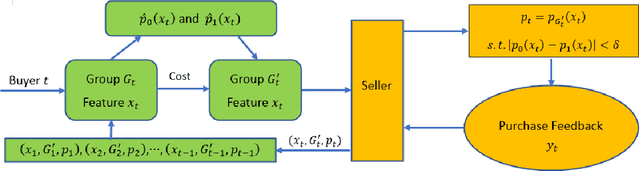
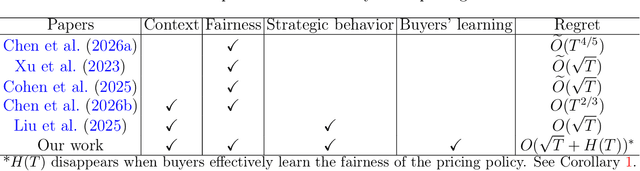
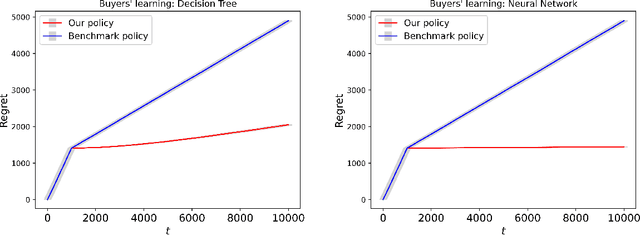
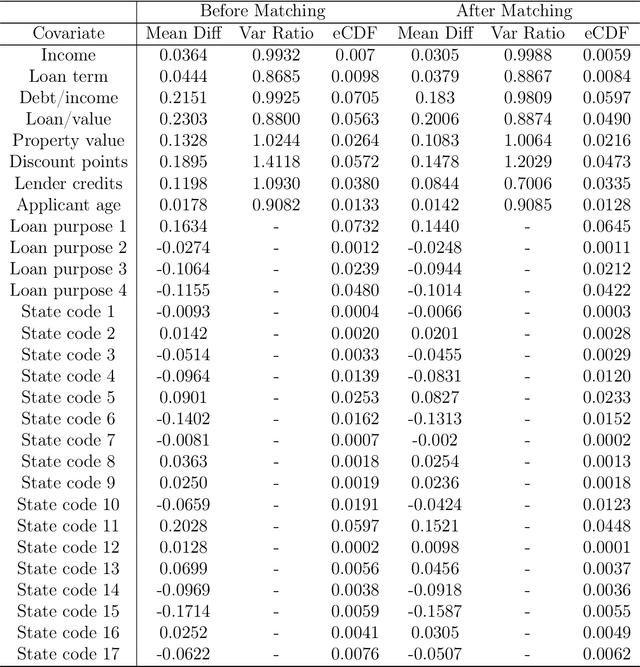
Contextual pricing strategies are prevalent in online retailing, where the seller adjusts prices based on products' attributes and buyers' characteristics. Although such strategies can enhance seller's profits, they raise concerns about fairness when significant price disparities emerge among specific groups, such as gender or race. These disparities can lead to adverse perceptions of fairness among buyers and may even violate the law and regulation. In contrast, price differences can incentivize disadvantaged buyers to strategically manipulate their group identity to obtain a lower price. In this paper, we investigate contextual dynamic pricing with fairness constraints, taking into account buyers' strategic behaviors when their group status is private and unobservable from the seller. We propose a dynamic pricing policy that simultaneously achieves price fairness and discourages strategic behaviors. Our policy achieves an upper bound of $O(\sqrt{T}+H(T))$ regret over $T$ time horizons, where the term $H(T)$ arises from buyers' assessment of the fairness of the pricing policy based on their learned price difference. When buyers are able to learn the fairness of the price policy, this upper bound reduces to $O(\sqrt{T})$. We also prove an $\Omega(\sqrt{T})$ regret lower bound of any pricing policy under our problem setting. We support our findings with extensive experimental evidence, showcasing our policy's effectiveness. In our real data analysis, we observe the existence of price discrimination against race in the loan application even after accounting for other contextual information. Our proposed pricing policy demonstrates a significant improvement, achieving 35.06% reduction in regret compared to the benchmark policy.
Low-Rank Contextual Reinforcement Learning from Heterogeneous Human Feedback
Dec 27, 2024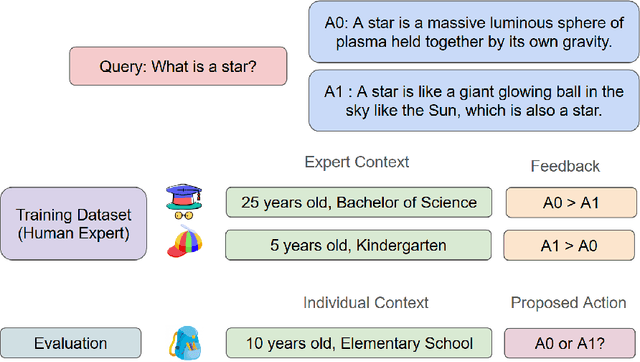
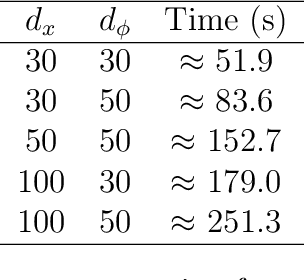
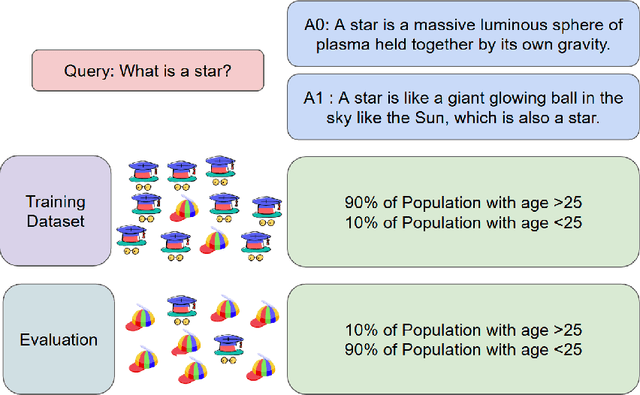

Reinforcement learning from human feedback (RLHF) has become a cornerstone for aligning large language models with human preferences. However, the heterogeneity of human feedback, driven by diverse individual contexts and preferences, poses significant challenges for reward learning. To address this, we propose a Low-rank Contextual RLHF (LoCo-RLHF) framework that integrates contextual information to better model heterogeneous feedback while maintaining computational efficiency. Our approach builds on a contextual preference model, leveraging the intrinsic low-rank structure of the interaction between user contexts and query-answer pairs to mitigate the high dimensionality of feature representations. Furthermore, we address the challenge of distributional shifts in feedback through our Pessimism in Reduced Subspace (PRS) policy, inspired by pessimistic offline reinforcement learning techniques. We theoretically demonstrate that our policy achieves a tighter sub-optimality gap compared to existing methods. Extensive experiments validate the effectiveness of LoCo-RLHF, showcasing its superior performance in personalized RLHF settings and its robustness to distribution shifts.
Privacy-Preserving Dynamic Assortment Selection
Oct 29, 2024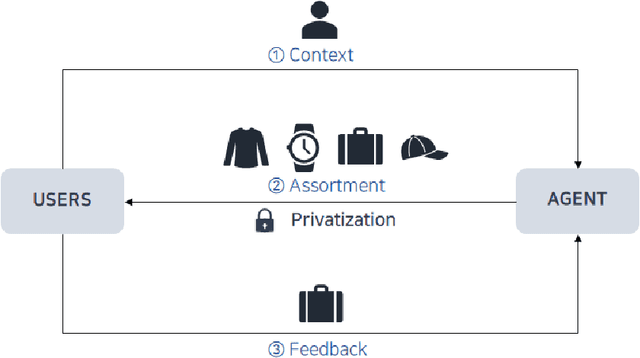
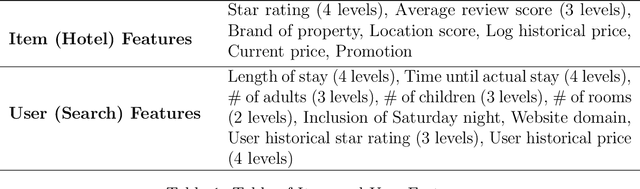
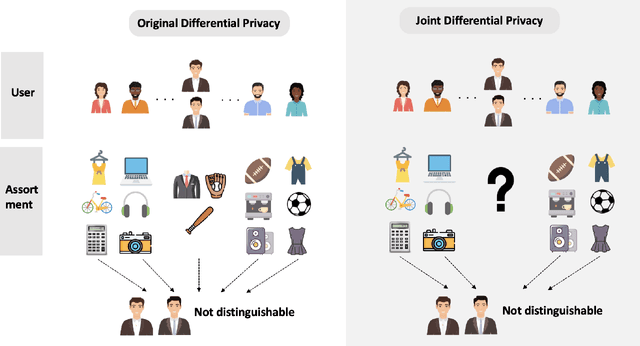
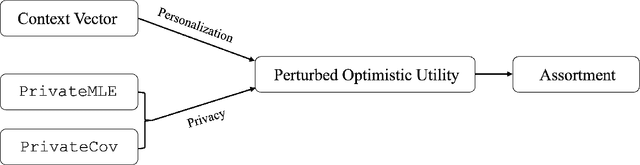
With the growing demand for personalized assortment recommendations, concerns over data privacy have intensified, highlighting the urgent need for effective privacy-preserving strategies. This paper presents a novel framework for privacy-preserving dynamic assortment selection using the multinomial logit (MNL) bandits model. Our approach employs a perturbed upper confidence bound method, integrating calibrated noise into user utility estimates to balance between exploration and exploitation while ensuring robust privacy protection. We rigorously prove that our policy satisfies Joint Differential Privacy (JDP), which better suits dynamic environments than traditional differential privacy, effectively mitigating inference attack risks. This analysis is built upon a novel objective perturbation technique tailored for MNL bandits, which is also of independent interest. Theoretically, we derive a near-optimal regret bound of $\tilde{O}(\sqrt{T})$ for our policy and explicitly quantify how privacy protection impacts regret. Through extensive simulations and an application to the Expedia hotel dataset, we demonstrate substantial performance enhancements over the benchmark method.